Welcome to Biolabs™
Solaris Biolabs is developing a new generation of high-efficiency indoor farming systems designed to deliver secure, year-round crop production with a materially lower environmental footprint. Dr Paul Hilton, Head of R&D, leads the technical development and deployment strategy, ensuring each farm module is engineered for consistent output, rapid replication, and measurable unit economics.
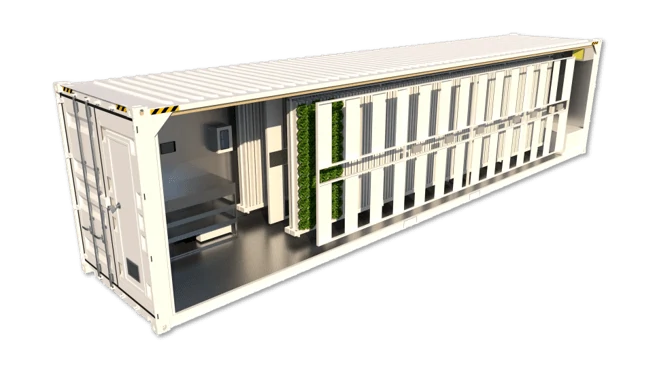
Operations focus on converting standard shipping containers and modular indoor spaces into fully integrated vertical farms, using stacked growing racks, precision horticultural lighting, and tightly controlled climatic conditions to maximise yield per square metre. Aeroponic cultivation systems eliminate soil, materially reduce water use, and enable fast, repeatable deployment. Each unit is configured as a plug-and-play production module, allowing Solaris Biolabs to scale capacity quickly while maintaining crop quality and predictable output. Advanced LED lighting systems supplied by technology partners such as GrowSpec deliver crop-specific light spectra, optimising growth rates while minimising electricity consumption.
A core differentiator of the Solaris Biolabs model is its clean-energy integration. Through the wider Solaris group, the business incorporates on-site solar photovoltaics, heat recovery and energy-optimisation systems into its farm designs, reducing operating costs and carbon intensity while improving resilience against energy price volatility. As Dr Hilton emphasises, captured heat and power are recycled directly into farm operations, supporting stable production economics.
Strategically, Solaris Biolabs targets high-value crops and ingredients that benefit from controlled-environment production, including speciality greens, nutraceutical inputs and regionally non-native crops. By locating production close to end-markets, the company reduces food miles, shortens supply chains and improves freshness, positioning Solaris Biolabs as a scalable, climate-resilient food and bio-inputs platform aligned with future food security and sustainability demands.
Operations focus on converting standard shipping containers and modular indoor spaces into fully integrated vertical farms, using stacked growing racks, precision horticultural lighting, and tightly controlled climatic conditions to maximise yield per square metre. Aeroponic cultivation systems eliminate soil, materially reduce water use, and enable fast, repeatable deployment. Each unit is configured as a plug-and-play production module, allowing Solaris Biolabs to scale capacity quickly while maintaining crop quality and predictable output. Advanced LED lighting systems supplied by technology partners such as GrowSpec deliver crop-specific light spectra, optimising growth rates while minimising electricity consumption.
A core differentiator of the Solaris Biolabs model is its clean-energy integration. Through the wider Solaris group, the business incorporates on-site solar photovoltaics, heat recovery and energy-optimisation systems into its farm designs, reducing operating costs and carbon intensity while improving resilience against energy price volatility. As Dr Hilton emphasises, captured heat and power are recycled directly into farm operations, supporting stable production economics.
Strategically, Solaris Biolabs targets high-value crops and ingredients that benefit from controlled-environment production, including speciality greens, nutraceutical inputs and regionally non-native crops. By locating production close to end-markets, the company reduces food miles, shortens supply chains and improves freshness, positioning Solaris Biolabs as a scalable, climate-resilient food and bio-inputs platform aligned with future food security and sustainability demands.